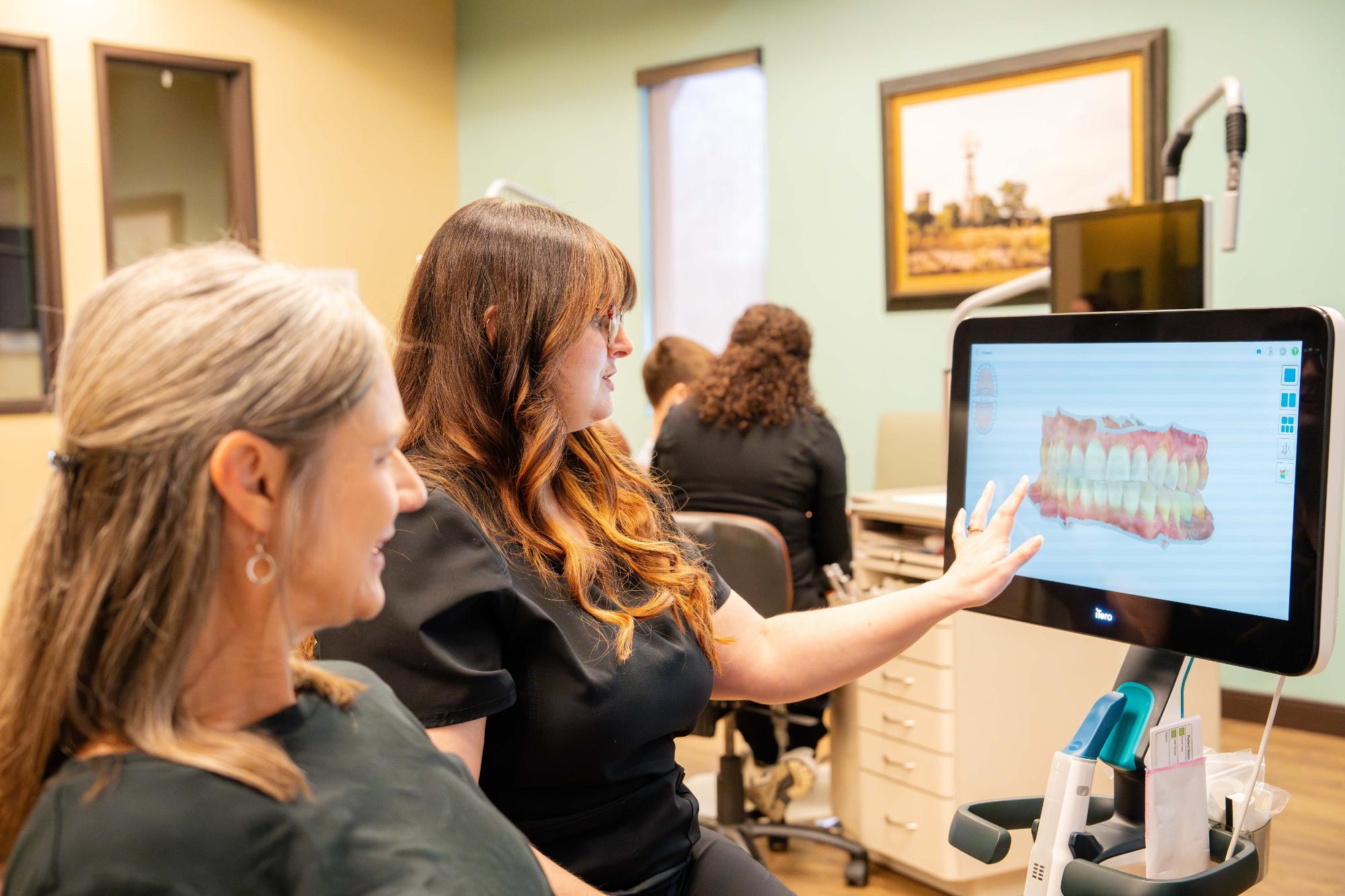
If you’ve had impression putty before, you probably remember it. Curious how a digital scan compares to traditional impressions? Expect fewer minutes in the chair, nothing gooey to bite down on, and a 3D model of your teeth you can look at on screen before you head home.
What Is a Digital Scan (Intraoral Scan)?
A digital scan is a three-dimensional record of your teeth and gums captured with a small handheld wand. The wand takes thousands of images per second and stitches them into an exact 3D model on screen. No trays, no putty, and no waiting for material to set in your mouth.
That model becomes a digital file (usually an STL or similar format) that gets used to design Invisalign trays, retainers, expanders, and other appliances. Because the file lives on a computer instead of a shelf, it can be pulled up years later for comparison.
You may hear a few scanner names during your visit. iTero, Trios, and Primescan are three of the most common systems in orthodontics, and they all work on the same basic idea: light in, 3D model out.
Traditional impressions rely on alginate or PVS (polyvinyl siloxane) material loaded into a tray and pressed against your teeth. That material is what triggers the gagging, the odd taste, and the occasional do-over. A digital scan replaces all of it.
How a Digital Scan Works, Step by Step
Here’s what happens: your teeth are lightly dried, a small wand glides over the upper arch, then the lower arch, then your bite. A 3D model builds on the screen in real time, so any gap gets re-scanned on the spot. Most scans take three to ten minutes.
- Prep. Your teeth get a quick, light drying and your cheeks are gently held back so the camera has a clear view. That’s the whole setup.
- Upper arch. The wand glides along the chewing surfaces, then the inside and outside of your upper teeth. You can swallow normally the entire time.
- Lower arch. Same path, bottom teeth. If you need a break, the wand pauses and picks up right where it left off.
- Bite scan. You close your teeth together while the wand records how your upper and lower arches meet. This is how your bite gets captured digitally.
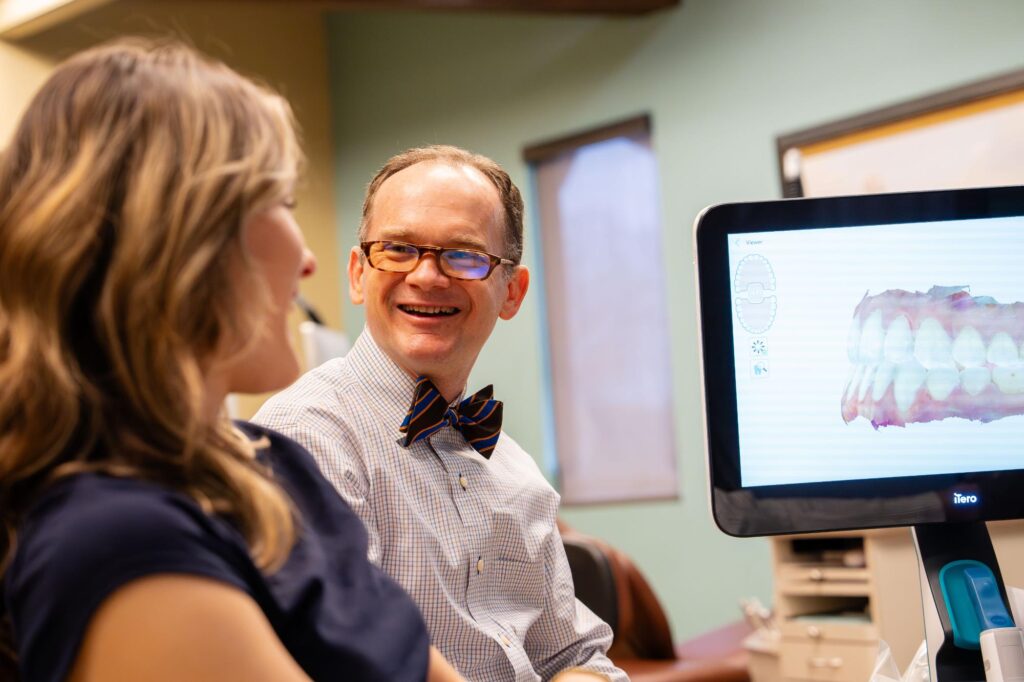
- Review and send. The 3D model appears on the monitor, gaps get filled in immediately, and then Dr. Layfield walks you through what he sees. From there the file goes to the lab or into smile design software.
What it actually feels like: light pressure against your teeth, a little cool air, and the tip of the wand touching your cheeks now and then. There’s no taste, nothing to hold in your mouth, and for most people, no gagging at all.
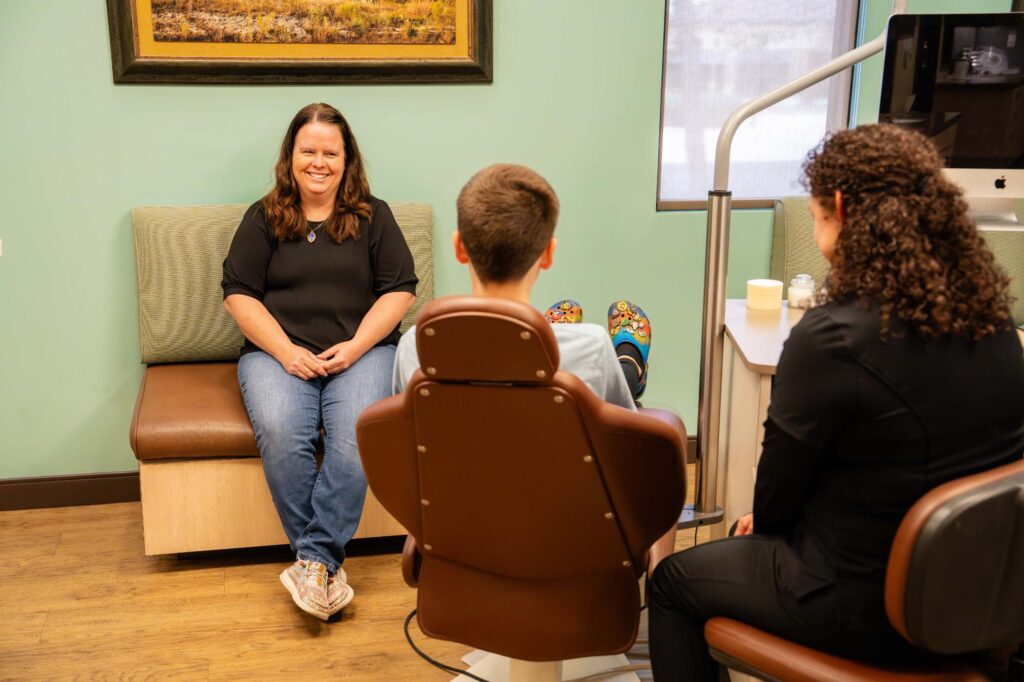
Kids often think the screen is the best part. Watching your own teeth appear in 3D beats staring at the ceiling for two minutes with a tray in your mouth.
Benefits of Digital Scans Over Impression Putty
The upgrade shows up in comfort first, but the practical wins matter just as much:
- More comfort. Nothing sets, hardens, or presses against the back of your throat. For anyone with a strong gag reflex, this is the difference-maker.
- Fewer do-overs. Distortions in putty often go unnoticed until the lab flags them. On a digital scan, a thin spot shows up on screen while you’re still in the chair.
- Faster turnaround. Files transmit electronically in minutes. No boxing up plaster models and waiting on shipping.
- Records that don’t degrade. Your scan is stored digitally, so a replacement retainer can often be made from the file you already have instead of a whole new visit.
- You can see your bite. The model rotates, zooms, and in many cases shows a simulated preview of where your teeth are headed.
- Less waste. No mixing bowls, no discarded material, and no shelves of plaster models collecting dust.
One more benefit that’s easy to overlook: scans make same-day starts realistic. When the file is ready immediately, planning can begin the same day as your free consult.
Digital Scan vs. Traditional Impression: Side-by-Side Comparison
| Factor | Digital Scan | Traditional Impression |
|---|---|---|
| Comfort | No material in the mouth; wand can pause anytime | Putty-filled tray held in place while material sets |
| Chair time | Usually 3 to 10 minutes for both arches | Similar per tray, longer once retakes are added |
| Accuracy | Comparable or better for most orthodontic uses | Accurate when technique is ideal, sensitive to voids and pulls |
| Retakes | Caught and corrected on screen during the visit | Often discovered later at the lab |
| Turnaround | File sent electronically within minutes | Models must be poured and shipped |
| Records storage | Digital file kept indefinitely | Physical models take up space and can chip or warp |
| Best for | Invisalign, retainers, expanders, progress tracking | Select appliances and deep subgingival margins |
Research comparing digital scanning with conventional impressions has generally found the fit of the finished appliance to be comparable or better with digital records for most orthodontic and restorative uses, particularly for full-arch orthodontic records, where small material distortions in putty can compound across the whole arch.
Two things drive that edge. First, scanning removes the material variables entirely: no setting time, no pull on the tray during removal, no air bubbles trapped against a tooth surface. Second, the model is verified while you’re still in the chair, so a thin or missing area gets re-captured in seconds instead of being discovered days later at the lab. Real-world accuracy is as much about catching small errors early as it is about the raw resolution of the device itself.
Chair time deserves a note. A single putty impression isn’t slow on its own, but retakes add up, and retakes are far more common when the material is the record. Scanning tends to win on total time.
Traditional impressions haven’t disappeared entirely. Certain lab-fabricated appliances and restorative cases with deep margins below the gumline may still call for physical material. Dr. Layfield will tell you upfront if your case is one of them.
Most people who’ve had both tend to prefer digital scanning, and it’s easy to see why once you’ve sat through both.
Who Is a Good Candidate for Digital Scanning?
Nearly everyone. Scanning works for kids, teens, and adults, and it tends to help most in the situations where putty was hardest to tolerate:
- Strong gag reflex or sensory sensitivities. Nothing sits in your mouth, and the wand stops the instant you need it to.
- Younger kids. Holding still with a full tray is a big ask for a seven-year-old. Following a wand on a screen is much easier.
- Invisalign candidates. Aligner design depends on a precise digital file, so scanning is the natural starting point.
- Retainers, expanders, and airway appliances. Each one needs accurate arch and bite data, which a scan captures in one pass.
- Anyone in active treatment. Progress scans can be taken with braces on to compare where your teeth started and where they are now.
A few situations call for small adjustments. Very limited mouth opening, active sores, or brackets with attachments may mean extra passes with the wand or a slightly different angle. Rarely does any of that rule scanning out.
According to the American Association of Orthodontists, children should have their first orthodontic evaluation by age seven. Digital scanning makes those early records easy to collect, even for a squirmy first grader.

Frequently Asked Questions About Digital Scans
Does a digital scan hurt?
No. A digital scan is non-invasive, with no material placed in your mouth and no numbing needed. You’ll feel light pressure from the wand tip and a bit of cool air. Most people describe it as easier than a routine cleaning.
How long does an intraoral scan take?
Usually three to ten minutes for both arches plus the bite. Simple retainer scans land at the shorter end. More complex cases, or scans taken with braces and attachments in place, take a few extra minutes.
Is a digital scan as accurate as an impression?
Yes. For most orthodontic uses, digital scans deliver accuracy that’s comparable to or better than conventional impressions, largely because errors get spotted and corrected during the visit rather than at the lab. Some restorative cases with deep margins below the gumline may still call for physical material.
Is there radiation from a digital scan?
No. Intraoral scanners use visible light or a low-power laser to capture surface images, not X-rays. A scan and an X-ray are two different things, and only the X-ray involves radiation.
Can I get aligners the same day as my scan?
Often, yes. Because the file is ready immediately, planning can begin during the same visit, which is what makes same-day starts possible. Actual tray delivery depends on lab fabrication time for your case.
What if I gag easily or have braces on?
Say the word and the wand comes out. Scanning can be paused, repositioned, and restarted as many times as you need without losing the images already captured. Brackets and wires don’t prevent a scan either, they just take a few more passes.
Digital scanning is standard at New Braunfels Orthodontic Associates, where Dr. Larry Layfield, a board-certified orthodontist, uses 3D digital scans for Invisalign, KLOwen custom digital braces, retainers, and airway appliances. If you’d like to see your own teeth on screen instead of dreading a tray of putty, families are welcome to learn more with a free consult. Your next step is simple: bring your questions, and our team will walk you through the scanner before anything ever touches your teeth. Your smile, made simple & clear.